

Commons:Village pump/Copyright
This Wikimedia Commons page is used for general discussions relating to copyright and license issues, and for discussions relating to specific files' copyright issues. Discussions relating to specific copyright policies should take place on the talk page of the policy, but may be advertised here. Recent sections with no replies for 7 days and sections tagged with {{section resolved|1=~~~~}} may be archived; for old discussions, see the archives.
- One of Wikimedia Commons' basic principles is: "Only free content is allowed." Please do not ask why unfree material is not allowed at Wikimedia Commons or suggest that allowing it would be a good thing.
- Have you read the FAQ?
- Any answers you receive here are not legal advice and the responder cannot be held liable for them. If you have legal questions, we can try to help but our answers cannot replace those of a qualified professional (i.e. a lawyer).
- Your question will be answered here; please check back regularly. Please do not leave your email address or other contact information, as this page is widely visible across the Internet and you are liable to receive spam.
- Please do not make deletion requests here – instead, use the relevant process for it.
 |
SpBot archives all sections tagged with {{Section resolved|1=~~~~}} after 1 day and sections whose most recent comment is older than 7 days. |
German FOP and photographs of unauthorized graffiti
[edit]An ongoing deletion request at Commons:Deletion requests/File:Hilden Nové-Město-Platz 9-10 (2).jpg raises a Freedom of Panorama question with broader policy implications.
.jpg)
The file shows unauthorized graffiti reproducing a copyrighted character. Under COM:FOP Germany, photographs of permanently displayed public works are generally allowed, and precedent has often supported keeping similar street art images. However, this case differs from original graffiti because it involves an additional layer of third-party copyright infringement.
This raises a policy question about how to balance existing FOP precedent with COM:Precautionary principle and Commons' requirement that files be genuinely free.
I did not close this myself, and am instead seeking additional input, given the nuanced interaction between Freedom of Panorama and third-party copyright. Please provide opinions in the DR. --Jonatan Svensson Glad (talk) 00:09, 3 February 2026 (UTC)
- It doesn't differ from Commons:Deletion requests/File:Vitoria - Graffiti & Murals 1127 12.JPG, as I pointed out in the linked thread. -- Ikan Kekek (talk) 05:58, 3 February 2026 (UTC)
- Deleted per Commons:Deletion requests/File:Peter Griffin in Hannover 2015.jpg. German law is clear on this, unauthorized depictions of copyrighted characters are not protected by FOP. Abzeronow (talk) 06:19, 3 February 2026 (UTC)
- What about the thread I linked? We need consistency in admins' rulings on cases in which DW and FOP seem to be in conflict. -- Ikan Kekek (talk) 06:22, 3 February 2026 (UTC)
- Germany and Spain may have different laws. @Strakhov: @DarwIn: and Spanish FoP is well not as clear cut you think. Abzeronow (talk) 06:25, 3 February 2026 (UTC)
- In any way, this is a legal quagmire. According to Gnom, the scholars are actually split as to whether German FOP mandates a lawful emplacement of a work to be applicable as a rights limitating statute. I know about Commons:Village pump/Copyright/Archive/2025/04#File:Alan Kurdi Graffiti.jpg and User talk:Gnom/Archive 4#Frage zum Rechtsverhältnis; geschütze Vorlage und Panoramafreiheit as pertinent previous exchanges in that subject. Regards, Grand-Duc (talk) 06:49, 3 February 2026 (UTC)
- User:Abzeronow, OK, if Spain and Germany are different in this respect, is that spelled out in COM:FOP Spain and COM:FOP Germany? It should be, if possible. Copyright laws and exceptions can be very confusing, and Commons should make them as clear as possible. -- Ikan Kekek (talk) 06:59, 3 February 2026 (UTC)
- In any way, this is a legal quagmire. According to Gnom, the scholars are actually split as to whether German FOP mandates a lawful emplacement of a work to be applicable as a rights limitating statute. I know about Commons:Village pump/Copyright/Archive/2025/04#File:Alan Kurdi Graffiti.jpg and User talk:Gnom/Archive 4#Frage zum Rechtsverhältnis; geschütze Vorlage und Panoramafreiheit as pertinent previous exchanges in that subject. Regards, Grand-Duc (talk) 06:49, 3 February 2026 (UTC)
- Germany and Spain may have different laws. @Strakhov: @DarwIn: and Spanish FoP is well not as clear cut you think. Abzeronow (talk) 06:25, 3 February 2026 (UTC)
- What about the thread I linked? We need consistency in admins' rulings on cases in which DW and FOP seem to be in conflict. -- Ikan Kekek (talk) 06:22, 3 February 2026 (UTC)
- I don't understand why the Spanish example was kept; IMO it should be deleted per Commons:Free depictions of non-free works#Not OK:
Photos of derivative graffiti without authorization from the copyright owner, even where two-dimensional artistic works are covered by commercial FoP
. -Consigned (talk) 20:36, 3 February 2026 (UTC)- So are you saying this should have been deleted because of a Commons policy that is stricter than Spanish FOP? Why does Commons do that to itself and its users? -- Ikan Kekek (talk) 22:12, 3 February 2026 (UTC)
- Can you provide evidence that Spanish FOP contradicts that policy? I don't see anything in COM:Spain that says so. The policy seems like a reasonable interpretation of FOP everywhere. -Consigned (talk) 10:00, 4 February 2026 (UTC)
- Since you are proposing an exception to Spanish FOP law, I think it is up to you to provide evidence for that. It's more reasonable, in my opinion, to assume that a law does not have such exceptions unless legal provisions, cases or legal opinions can be cited to demonstrate such an exception. Otherwise, you're creating an unnecessary additional prohibition on Commons. Ikan Kekek (talk) 15:38, 4 February 2026 (UTC)
- Per COM:ONUS the burden of proof is on the person arguing for the file to be kept. And per COM:PCP, when in doubt, we should not make assumptions around law, we should tread towards the precautionary option which is deletion. Consigned (talk) 20:51, 4 February 2026 (UTC)
- The onus is actually trickier than that. For one thing, the doubt has to be "significant." For another thing, the precautionary principle is more about whether a particular file is PD under an understood law than a requirement that in undetermined areas of law, we must presume the broadest imaginable interpretation of copyright. Jmabel ! talk 01:32, 5 February 2026 (UTC)
- If I'm interpreting "the broadest imaginable interpretation of copyright" correctly, your description of the precautionary principle seems to align well to this case - since it seems like Spanish law is unclear as to whether the original artist's right to restrict reproduction is lost due to FOP after being reproduced or derived in public without authorization, the broadest interpretation of copyright is that the original artist retains that right. My personal interpretation is that it isn't reasonable that this right can be relinquished without the rightholder's consent - to me this seems contradictory with the principles behind the Berne Convention, which ENWP's intro summarizes as providing creators
with the means to control how their works are used, by whom, and on what terms
. This aligns with the German court opinion discussed in Commons:Deletion requests/File:Peter Griffin in Hannover 2015.jpg. I am very interested in learning if Spanish or any other countries' law, court cases, or legal analyses discuss this scenario, but in their absence, we should presume the broadest interpretation of copyright. -Consigned (talk) 09:36, 5 February 2026 (UTC)- No we shouldn't. Just delete everything, then, why don't you? The broadest possible interpretation is that no evidence of true authorship is enough, etc., etc. -- Ikan Kekek (talk) 04:35, 6 February 2026 (UTC)
- @Consigned: intentionally or unintentionally, you grabbed a phrase out of what I wrote and pulled it out of context to say the opposite of what I said. If you read more closely you will see that I am saying that the precautionary principle does not require that in undetermined areas of law, we must presume the broadest imaginable interpretation of copyright. - Jmabel ! talk 06:18, 6 February 2026 (UTC)
- Wow, my apologies, I completely misinterpreted and clearly missed a word or two. I'll try to read more carefully in the future, and thank you for explaining it again. -Consigned (talk) 09:36, 6 February 2026 (UTC)
- @Ikan Kekek: yes, I think that we should "Delete everything" where there is significant doubt in its freedom, which is in the COM:PCP. Obviously we disagree on "significant doubt", but people are allowed to have different opinions; at the end of the day hopefully the discussion and different perspectives help arrive at an overall consensus. -Consigned (talk) 09:36, 6 February 2026 (UTC)
- You're suggesting I don't believe you're "allowed" to have your own opinion? Would it make you feel freer if I stated that I take the presumption to permit you to have one? The point is, your personal "significant doubt" is a legal opinion you're making up to unnecessarily delete a large swath of files no court or legal provision said we had to delete. That's unnecessarily destructive. Ikan Kekek (talk) 15:18, 6 February 2026 (UTC)
- Do you have any thoughts about my argument itself, whether it aligns with legal language, cases, or opinions? Or are you just disputing it because of the outcome? Consigned (talk) 12:01, 8 February 2026 (UTC)
- I'm not an expert on law. Are you? My problem with your argument is that I don't think you have the legal expertise to create new law and thereby create a whole new category of deletions. Ikan Kekek (talk) 02:54, 9 February 2026 (UTC)
- I'm not an expert on law, but I'm pretty familiar with Commons policies. I'm not creating a new category, I'm consistently applying our copyright rules from Commons:Free depictions of non-free works#Not OK:
Not OK: Photos of derivative graffiti without authorization from the copyright owner, even where two-dimensional artistic works are covered by commercial FoP
. Can you provide the policy basis for your comment "[the rule above is] generally irrelevant when it's trumped by freedom of panorama" at this DR? That seems wildly contradictory since the rule explicitly mentions freedom of panorama. -Consigned (talk) 10:24, 9 February 2026 (UTC)- You're right to call me out for that. I should have said that was my understanding, based on decisions and comments by admins in previous deletion requests threads. But having said that, I maintain that Commons should not be deleting photos taken in countries that do not clearly have this exception to FoP laws. I see that this is an argument with a general guideline rather than just with you, though. Ikan Kekek (talk) 13:26, 9 February 2026 (UTC)
- I'm not an expert on law, but I'm pretty familiar with Commons policies. I'm not creating a new category, I'm consistently applying our copyright rules from Commons:Free depictions of non-free works#Not OK:
- I'm not an expert on law. Are you? My problem with your argument is that I don't think you have the legal expertise to create new law and thereby create a whole new category of deletions. Ikan Kekek (talk) 02:54, 9 February 2026 (UTC)
- Do you have any thoughts about my argument itself, whether it aligns with legal language, cases, or opinions? Or are you just disputing it because of the outcome? Consigned (talk) 12:01, 8 February 2026 (UTC)
- You're suggesting I don't believe you're "allowed" to have your own opinion? Would it make you feel freer if I stated that I take the presumption to permit you to have one? The point is, your personal "significant doubt" is a legal opinion you're making up to unnecessarily delete a large swath of files no court or legal provision said we had to delete. That's unnecessarily destructive. Ikan Kekek (talk) 15:18, 6 February 2026 (UTC)
- If I'm interpreting "the broadest imaginable interpretation of copyright" correctly, your description of the precautionary principle seems to align well to this case - since it seems like Spanish law is unclear as to whether the original artist's right to restrict reproduction is lost due to FOP after being reproduced or derived in public without authorization, the broadest interpretation of copyright is that the original artist retains that right. My personal interpretation is that it isn't reasonable that this right can be relinquished without the rightholder's consent - to me this seems contradictory with the principles behind the Berne Convention, which ENWP's intro summarizes as providing creators
- The onus is actually trickier than that. For one thing, the doubt has to be "significant." For another thing, the precautionary principle is more about whether a particular file is PD under an understood law than a requirement that in undetermined areas of law, we must presume the broadest imaginable interpretation of copyright. Jmabel ! talk 01:32, 5 February 2026 (UTC)
- @Ikan Kekek: The freedom of panorama is codified in Article 35(2) and it indeed has no restriction, yet this article is part of Chapter II. This chapter ends with Article 40 bis:
Los artículos del presente capítulo no podrán interpretarse de manera tal que permitan su aplicación de forma que causen un perjuicio injustificado a los intereses legítimos del autor o que vayan en detrimento de la explotación normal de las obras a que se refieran
, and it roughly says that the articles in the whole Chapter II cannot be interpreted in a way to cause unjustified harm on the interest of the author. It is clear to me that if an artist decides to place an artwork in a public space, they are aware of that people can take photos and use them commercially. However, in the case of Graffiti containing derivative works, the Graffiti artists, in general, don't ask for permission to the original author. Further reproduction of the Graffiti would transform an unlawful reproduction of their work into a legal one and that goes against the legitimate interest of the original author. Günther Frager (talk) 10:17, 6 February 2026 (UTC)- Thanks, what seems like an official translation at this link (direct pdf download) translates it as
The Articles of this Chapter shall not be construed so that their implementation is capable of unreasonably prejudicing the author's legitimate interests or adversely affecting the normal exploitation of the works to which they refer.
I agree that a work (or a version of it) entering PD due to an unauthorized reproduction seems like both "unreasonably prejudicing the author's legitimate interests" and "adversely affecting the normal exploitation of the works". -Consigned (talk) 15:13, 8 February 2026 (UTC)
- Thanks, what seems like an official translation at this link (direct pdf download) translates it as
- Per COM:ONUS the burden of proof is on the person arguing for the file to be kept. And per COM:PCP, when in doubt, we should not make assumptions around law, we should tread towards the precautionary option which is deletion. Consigned (talk) 20:51, 4 February 2026 (UTC)
- Since you are proposing an exception to Spanish FOP law, I think it is up to you to provide evidence for that. It's more reasonable, in my opinion, to assume that a law does not have such exceptions unless legal provisions, cases or legal opinions can be cited to demonstrate such an exception. Otherwise, you're creating an unnecessary additional prohibition on Commons. Ikan Kekek (talk) 15:38, 4 February 2026 (UTC)
- Can you provide evidence that Spanish FOP contradicts that policy? I don't see anything in COM:Spain that says so. The policy seems like a reasonable interpretation of FOP everywhere. -Consigned (talk) 10:00, 4 February 2026 (UTC)
- So are you saying this should have been deleted because of a Commons policy that is stricter than Spanish FOP? Why does Commons do that to itself and its users? -- Ikan Kekek (talk) 22:12, 3 February 2026 (UTC)
- Deleted per Commons:Deletion requests/File:Peter Griffin in Hannover 2015.jpg. German law is clear on this, unauthorized depictions of copyrighted characters are not protected by FOP. Abzeronow (talk) 06:19, 3 February 2026 (UTC)
- Perhaps the 2nd paragraph of Sec. 59 comes into play: "The reproduction may not be carried out on a building." Per w:de:Panoramafreiheit#Deutschland (translated): The reproduction of the work "on a building" is expressly prohibited. For example, a protected monument in the market square may not be depicted in murals or stucco decorations on buildings. The underlying rationale is that the purpose of the freedom of streetscapes is not to allow reproductions to be used in accordance with the original function of the work without compensating the author. As far as the literature is concerned, an interpretation is often favored that only the exterior of the building is meant. This would mean that, on the one hand, the reproduction of a fresco above a house entrance would be impermissible, but on the other hand, its copying on the wall in the stairwell of a building would be permitted.
- Assuming an unauthorized graffiti of a copyrighted character on the outdoor wall of a building, the reproduction itself is already infringing as it reproduces a copyrighted character. By using the logic, WikiCommons photographers whose photographs are not PD (e.g CCBY and CCBYSA) are protected: it's illegal to paint an image of an existing photo by a Wikipedian on the outdoor walls, or even beam an image of the same photo using modern technology (like laser or AR). And since such reproductions are already illegal under Sec. 59(2), any photo of such reproductions is also an infringement from the beginning.
- See this discussion. JWilz12345 (Talk|Contributions) 11:34, 3 February 2026 (UTC)
- Just to clarify: Graffiti always falls under FOP under German copyright law, except (with this exception being disputed and not yet decided by the courts) if the graffiti itself is an unauthorised copy of a protected work. Gnom (talk) 17:50, 3 February 2026 (UTC)
- §59(2) UrhG prohibits reproducing a protected work onto a building. That is, using a building as the medium for copying an existing work (e.g. painting a mural of a copyrighted character on a wall). This clause is aimed at preventing unauthorized use of buildings as canvases for derivative works. However, this restriction applies to the act of creating the reproduction, not to photographing it. The photographer is not reproducing the work on a building, but rather capturing an existing work on a building. §59(1) governs that situation, and as long as the work is permanently located in a public space, the photo is permitted. So while the graffiti itself may be infringing, the photo of it is not necessarily a reproduction
on a building
within the meaning of §59(2). --Jonatan Svensson Glad (talk) 10:30, 4 February 2026 (UTC)- Seems dodgy to me. Effectively, a derivative work of a copyvio is somehow kosher. So I could take any work of art, paint (or otherwise affix) a copy anonymously onto the side of a building, photograph that, and as long as no one can prove I'm the same person who painted it, I have a clean copyright on the photo? So if something like File:Okanogan, WA - Frank Matsura photo 02.jpg used a still-copyrighted photo without permission, and was located in Spain, my resulting photo would be fine? - Jmabel ! talk 20:17, 4 February 2026 (UTC)
- I agree that it does sound bonkers, and I understand the concern. That said, this is my reading of German FOP law, a photograph of an existing work permanently located in a public space is generally allowed, even if the work itself is an infringing derivative. My comment in the above DR is of note in my opinion. On Commons, the only situation where a file does not need to be free in both the source country and the US is under FOP. That said, I think we should at least attempt to document cases like this clearly. Even if a photograph would be legally publishable under the source country's FOP, Commons still requires that it be freely usable in the US. Doing so would help avoid confusion and provide consistency for contributors encountering these edge cases... --Jonatan Svensson Glad (talk) 20:57, 4 February 2026 (UTC)
- Seems dodgy to me. Effectively, a derivative work of a copyvio is somehow kosher. So I could take any work of art, paint (or otherwise affix) a copy anonymously onto the side of a building, photograph that, and as long as no one can prove I'm the same person who painted it, I have a clean copyright on the photo? So if something like File:Okanogan, WA - Frank Matsura photo 02.jpg used a still-copyrighted photo without permission, and was located in Spain, my resulting photo would be fine? - Jmabel ! talk 20:17, 4 February 2026 (UTC)
- §59(2) UrhG prohibits reproducing a protected work onto a building. That is, using a building as the medium for copying an existing work (e.g. painting a mural of a copyrighted character on a wall). This clause is aimed at preventing unauthorized use of buildings as canvases for derivative works. However, this restriction applies to the act of creating the reproduction, not to photographing it. The photographer is not reproducing the work on a building, but rather capturing an existing work on a building. §59(1) governs that situation, and as long as the work is permanently located in a public space, the photo is permitted. So while the graffiti itself may be infringing, the photo of it is not necessarily a reproduction
- Just to clarify: Graffiti always falls under FOP under German copyright law, except (with this exception being disputed and not yet decided by the courts) if the graffiti itself is an unauthorised copy of a protected work. Gnom (talk) 17:50, 3 February 2026 (UTC)


Copyright status of old photos in modern books?
[edit]If a photo exists that should be free to use on account of age, but I only have a copy of it as reproduced in a book that is more recent and therefore still under its own copyright, can I take a photo of the relevant page, crop it and use just the photo, optionally crediting it as "as seen in [book name]"? My instinct is that it would be preferable to cite the book as a source, but I can also imagine that causing problems.
(Secondary question: in this case the photos are of a construction site circa 1910 +/-5 years, so I think it's very likely they're beyond the 70 years after death rule and no author is credited. How certain do I need to be?)
(Prototyperspective (talk · contribs) suggested moving this over here from where I'd originally posted it. They mentioned something about "the validated longevity record is 122 years". Given the context of the photos showing a construction site, I imagine the photographers would not have been young children; probably at least in their early 20s.)
Anothersignalman (talk) 15:06, 4 February 2026 (UTC)
- (Better to move the full thread, I also addressed the first part and I doubt or am very unsure the longevity record inference approach is the right way here so I mainly said that question is more complicated when I addressed the second question.) Prototyperspective (talk) 15:19, 4 February 2026 (UTC)
- My apologies.
- For a case study, I've used a photograph here - [1] (the one in the oval frame) - which was taken in 1905 +/-1 year. In this case I know the author died in 1941, but the book it's in was published in 2002. Note I stuffed up the filename upload and I've put in a request to change that, so it might change shortly, but I made a point of citing the source in the caption on that page.
- Anothersignalman (talk) 15:36, 4 February 2026 (UTC)
- We'd need more info, like the country of origin of the photo/book, because in some countries copyright protection is linked to time of (first) publication.
- And the duration for {{PD-old-assumed}} is 120 years after creation of the photo. Nakonana (talk) 15:58, 4 February 2026 (UTC)
- The photographs are about 80 miles / 130 km east of Melbourne, Australia. Anothersignalman (talk) 16:07, 4 February 2026 (UTC)
- As you say, looking over Commons:Publication, it says the date of publication is the key number for starting the clock on copyright. I suppose the net rule across Commons would be the latest time possible across all possible rule sets, so in this case if the first publication is sixty years after the author's death, then the latter really doesn't matter because the clock hadn't started yet. The caption in the source book says "[the photographer, who died in 1941] often made his own postcards [of photos taken between 1904 and 1912] and sent them to family and friends", but that's not ironclad evidence that this specific photo, or any of the others in the book, was "published" before it appeared in the book from 2002.
- There are two names on the cover of the book (ISBN 0-9581266-0-7), credited as "Compiled by" not authors:
- John Kiely, who from a quick Google might have been born 1934 and died March 2025 (I'm not certain this is the right person.)
- Russell Savage MLA, born 1948, still alive today, credited elsewhere as having these photos in his collection.
- All up, I think I need to delete the photo, at least for now :(
- Anothersignalman (talk) 18:43, 4 February 2026 (UTC)
- There are two separate issues here: status in the country of origin and status in the U.S.
- In most countries other than the U.S. (but not quite all), publication is irrelevant to copyright. If a known author died in 1941, or any time up to 1955, then in any country where the copyright duration is "p.m.a. + 70" (the most common), their work is simply in the public domain.
- In the U.S., however, until very recently copyright was overwhelmingly based on publication date, and copyrights for older works are "grandfathered in." Unfortunately, 2002 is the last year that is grandfathered in. According to the COM:Hirtle chart, if the first publication of the photo was in a book published in 2002, it is copyrighted in the U.S. through 31 December 2047. - Jmabel ! talk 20:33, 4 February 2026 (UTC)
- The only way around both the US and AU restrictions might be to find out whether "published" includes "postcards copied and sent to friends", which must have been done before the photographer died in 1941. Anothersignalman (talk) 07:20, 5 February 2026 (UTC)
- The photographs are about 80 miles / 130 km east of Melbourne, Australia. Anothersignalman (talk) 16:07, 4 February 2026 (UTC)
.svg/20px-Pictogram_voting_comment_(orange).svg.png) Comment It is very unlikely that a picture from around 1910 to be still under a copyright, specially for a picture from Australia, which a shorter copyright term than, e.g. European countries. Yann (talk) 20:30, 4 February 2026 (UTC)
Comment It is very unlikely that a picture from around 1910 to be still under a copyright, specially for a picture from Australia, which a shorter copyright term than, e.g. European countries. Yann (talk) 20:30, 4 February 2026 (UTC)
- If that was first publication, it will be copyrighted in the U.S., as my remark above (cross-posted with yours) makes clear. - Jmabel ! talk 20:34, 4 February 2026 (UTC)
- I tracked down one of the two book authors via Facebook, they said:
"There is no copy right on any of the photographs. They were owned by the late (second author). A small number were supplied by (third person) who gave them to me freely. (Photographer) worked as a railway time keeper and I suspect he had a contract with the (government) to photograph works on the (railway under construction). All the photographs were given to the Public Records Office after the book was published and are accessible there. You can do what you wish with the images for Wikipedia."
- If that was first publication, it will be copyrighted in the U.S., as my remark above (cross-posted with yours) makes clear. - Jmabel ! talk 20:34, 4 February 2026 (UTC)
- If nothing else, I think the first and last lines are essentially permission to upload whatever I want from the book, and tag it as CC0. Is that a fair reading? Anothersignalman (talk) 10:34, 7 February 2026 (UTC)
- It certainly can't be CC-0. The only way something can become CC-0 is that someone owns the copyright and specifically grants a CC-0 license as a statement that they will not pursue any of their rights, and the image can be treated as if it is in the public domain.
- Unless the hand-off to the Public Records Office counts as publication (any opinions there would be very welcome), I stand by my statement about U.S. copyright. And I wouldn't expect the author to be an expert on U.S. copyright law, some of which is very tricky for publication of old, previously unpublished works, especially between 1 March 1989 and 31 December 2002, when the law was frankly pretty ridiculous, but has been upheld. It sounds like they wish to renounce the U.S. copyright, and I would imagine they can do that through the COM:VRT process (@Krd: would you agree?).
- Thanks Jmabel (talk · contribs). To clarify: CC-0 is the same thing, or slightly different, to "in the public domain"?
- I wasn't able to find the photos on our Public Records Office website, but I did find a small handful of them on the State Library site which explicitly states on a few files I randomly checked, "Copyright status | This work is out of copyright" and "Conditions of use | No copyright restrictions apply." But that would only cover Australian law, and I'm guessing it isn't transitory to photographs in a consecutive set if one or two are on the website but others are in the book. For US law purposes, does the act of the original photographer making copies and sending to "family and friends" (pre-1941) count as him publishing them? And if the answer is yes, and then if I download from the State Library website and upload to Commons, what copyright tags/settings should I use? Anothersignalman (talk) 17:21, 8 February 2026 (UTC)
- The effect of CC-0 is that you can safely treat the content as if it were in the public domain. But that doesn't mean they are "the same". See Category:PD-release like license tags for many other analogous tags. - Jmabel ! talk 20:51, 8 February 2026 (UTC)
- 1941 wouldn't help (or at least wouldn't help yet). If enough copies were sent at some date to amount to publication, then 95 years after publication occurred the content would be PD in the U.S. So, if we could show publication in 1930 or earlier, that's good now; that date moves year-for-year from now through 2047, after which they are in the public domain regardless. That is, unless we find a "worst case": if it was first published between 1952 and 1977, it wouldn't be in the public domain in the U.S. until 95 years from publication, or, more precisely, 1 January of the following year, which would be even later than 2047.
- Again: this is all a hideous mess in U.S. copyright law. For works first published in 2003 or later, U.S. copyright law is much saner, and much more similar to other Berne Convention countries. - Jmabel ! talk 21:03, 8 February 2026 (UTC)
- OK, and the only reason we need to care at all about US copyright law is because Wiki is hosted there, and so it applies as a blanket policy across all Wiki content in addition to all local requirements? Anothersignalman (talk) 03:42, 9 February 2026 (UTC)
- Kind of. Not all of our servers are in the U.S., but as I understand it, that is where we are legally located. - Jmabel ! talk 06:46, 9 February 2026 (UTC)
- For what it's worth, I appreciate the patience you've shown me :)
- So I'm not sure what the appropriate measures are for this photo, which was the test case above. I nominated it for deletion early in the conversation but the consensus was to keep it, and it's since been renamed to fix my typo (I'd originally named it "9 miles 5 chains") which I'm hoping is the reason the deletion log is now redlinked. I think the discussion then was mainly focused on Australian law, without reference to that of the USA. Hopefully the discussion can be recovered, but I don't know how to do that. I've asked on the file talk page.
- But on the main page for the file it now says:
"The author died in 1941, so this work is in the public domain in its country of origin and other countries and areas where the copyright term is the author's life plus 80 years or fewer.
This work is in the public domain in the United States because it was published (or registered with the U.S. Copyright Office) before January 1, 1931."
- Kind of. Not all of our servers are in the U.S., but as I understand it, that is where we are legally located. - Jmabel ! talk 06:46, 9 February 2026 (UTC)
- OK, and the only reason we need to care at all about US copyright law is because Wiki is hosted there, and so it applies as a blanket policy across all Wiki content in addition to all local requirements? Anothersignalman (talk) 03:42, 9 February 2026 (UTC)
- If nothing else, I think the first and last lines are essentially permission to upload whatever I want from the book, and tag it as CC0. Is that a fair reading? Anothersignalman (talk) 10:34, 7 February 2026 (UTC)

- The latter line is at least not provably correct, since all we know is that it was taken c.1905 not when the photo/postcard was sent to its recipient. And even if we could show that, it probably wouldn't matter because Commons:Publication says "copies" (we don't know if this was a copy or the only/original photograph); "to the public" (which excludes family and friends), and it's also not clear whether any version of the photograph ever arrived within US jurisdiction before the book in 2002, or if the US law considers actions worldwide to count. There's a copy of the book on eBay at time of writing which says it's being sent from the US so there's probably (but not definitely) a copy of the book from 2002, and therefore the photo from c.1905, there today, so by that measure the date of publication in the USA could be this year or it might not even have happened yet. I suppose another question is whether, for the purposes of Wikimedia uploads, we need to be absolutely 100% certain of a particular fact, or if there is some sort of likelihood threshold? Has there ever been an instance of an author faking their own death, being revealed say a few decades later, and then successfully claiming copyright on things that were, in the meantime, widely believed to be in the public domain?
- Anyone else feel like their brain is dribbling out their ear yet? Anothersignalman (talk) 14:30, 9 February 2026 (UTC)
- The only respect in which it would matter whether
any version of the photograph ever arrived within US jurisdiction
at some point in time is if it was published without notice or registration as required in the U.S. before 1 March 1989, and was published in the U.S., it could have lost its copyright immediately. Someone bringing a copy privately into the U.S. probably wouldn't count; someone selling by mail to the U.S. certainly would. - Jmabel ! talk 19:42, 9 February 2026 (UTC) - For 2002 publication in a country with which the U.S. has copyright relations, it is completely irrelevant whether any copy reached the U.S. - Jmabel ! talk 19:46, 9 February 2026 (UTC)
- @Yann and Inertia6084: - FYI, this thread is why I originally nominated my own upload for deletion.
- The above image link now has its deletion discussion correctly linked, thanks to Inertia6084 (talk · contribs).
- Yann (talk · contribs) said "It is very unlikely that a picture from around 1910 to be still under a copyright, specially for a picture from Australia, which has a shorter copyright term than, e.g. European countries. Here the design around the picture is obviously old, not from 2002, so it was published before that date." and Inertia6084 (talk · contribs) agreed; there's no mention in that thread of US copyright law.
- I wonder how many other images on Commons have the same sort of issue - fine in home country, but problematic for USA - and whether there should be a system to tag those images (perhaps specifically for 1989-2002 publications) for hosting external to USA as a workaround? a) Is that technically feasible, b) would it work legally, c( how much effort would it take to implement and maintain, on a rolling basis?, d) what sorts of negative impacts could it have, e.g. longer load times for those items? Anothersignalman (talk) 05:55, 10 February 2026 (UTC)
- The only respect in which it would matter whether
Regarding File:UrubuPix.png
[edit]
Please take a look at it and (especially) at its description, and tell me whether everything is all right with it and whether the license used is okay. I need that information before using it on wikt:Urubu do Pix and w:pt:Urubu do Pix. There might be a few little issues, as far as I am concerned. (Note: A week ago, I uploaded the bottom-right image in its entirety, but it has been deleted due to uncertain licensing, especially regarding the vulture photo. Please do see the full discussion on my talkpage, for context.) In my understanding of it, the image should be allowed here, because it is a derivative work of authorless derivative works of a royalty-free photograph, which could somehow be classified therein as a de minimis component of the meme images and of my simple collage of them. I would say that, perhaps, the relative low quality of some parts of the image(s), as well as the unknown (and unknowable) authorship, are important factors that support my point. Bytekast (talk) 21:11, 6 February 2026 (UTC)

- @Bytekast: I'm confused on a few counts:
- what exactly are the licensing terms of the "royalty-free photograph"?
- what do you mean by "authorless"?
- Jmabel ! talk 23:23, 6 February 2026 (UTC)
- @Jmabel Of course:
- 1. As you can see on the imagepage's description, the original (or oldest—from 2006) home of that photograph, the first site to which the photographer uploaded it, is alamy, whose "Individual license" prescribes (presented below after the site's style):
 Unlimited usage across websites and social media platforms including short-form-video on video sharing sites
- Can be used in digital publishing and digital marketing
- Print runs of up to 5,000 for print marketing and self-published book
- For one user only
- Also, it has no release, either of "Model" or of "Property".
- On iStock, where the photo was reposted 14 years later (in 2020) by the same guy, there are a "standard" and an "extended" license. See more here.
- I couldn't find any license information for the shutterstock photo, but I suppose the principle is similar, otherwise the O.A. (original author) would not have uploaded it there too (in 2020, months prior to iStock).
- Sidenote: see here (a screenshot) about the "royalty-free" part.
- Turns out someone bought that image (from one of those three sites, or even elsewhence), as is clearly evidenced by the absence of a watermark on the derivative works, on which the photo is additionally mirrored.
- 2. By authorless (also on M-W) I meant "with no known author(s)". The authors of those memes—perhaps some bored Brazilian teens who found the scam weirdly/ridiculously funny, which I also did—cannot be determined, as is often the case with memetic (read ephemeral) media. Even if they could be, I don't think they would mind our upload (or "repost") of their memes without their "permission"; memes are born in the public domain by their own nature, which I argued in my first reply in the talkpage discussion.
- 1. As you can see on the imagepage's description, the original (or oldest—from 2006) home of that photograph, the first site to which the photographer uploaded it, is alamy, whose "Individual license" prescribes (presented below after the site's style):
- Bytekast (talk) 00:29, 7 February 2026 (UTC)
- "Print runs of up to 5,000 for print marketing and self-published book" is still too weak for our requirement for a free license allowing commercial reuse.
- Insofar as there is anything copyrightable, failure to name yourself when publishing is not a waiver of copyright, and Commons:Project scope/Precautionary principle specifically rejects "The copyright owner will not mind/should be pleased that we have disseminated their work," as an acceptable basis for us to accept content. It could be argued whether or not these anonymous authors did anything above the threshold of originality, but if they did then that would be a problem.
- But really, I think the first problem is the deadly one: a license too weak for our requirement for a free license allowing commercial reuse. - Jmabel ! talk 00:54, 7 February 2026 (UTC)
- I comprehend and agree… Well, what about the Royalty Free team license (for more than one user)?
- Use across all platforms all-media worldwide
- Multiple re-use
- Anyway, please keep in mind that we do not know where the creator of the original/first image in my collage (top-left corner) got the vulture photo, and we can't possibly ask them.
- It could have been from Alamy, or from either other imagebank, or from somewhere else entirely. Since the photos, once dewatermarked (or waterunmarked) by purchase, look the same (because they are really the same photo (re)uploaded to a number of places by its creator), there is no way to tell.
- The weak/not fully free license issue would be a problem only if my intention were to upload the alamy photo to Commons, which it is not.
- I still think my collage is fine & free, and I am here seeking community feedback to either deny or confirm that outlook ultimately. I feel like that uncertainty of provenance (among other factors; see image description) makes the image free by default, but perhaps I am missing something and that is actually an unacceptable excuse around here. Not sure…
- And what about my de minimis argument? Is it sound? Or is the vulture too maximis and therefore my argument is absurd? Bytekast (talk) 01:40, 7 February 2026 (UTC)
- The vulture is well over TOO in most countries of the world, certainly so in the U.S., and everything we host here is supposed to be either licensed or PD in the U.S. It is way to prominent in the photo for any other sort of de minimis argument to be plausible. - Jmabel ! talk 07:30, 7 February 2026 (UTC)
- Of course. Well then, it ought to count as "licensed"—oughtn't it?—because it was bought by the meme's creator (or likely at first by a silly scammer desperate for some quick money, without much effort), edited (with mirroring) and used in a derivative work, which then spread into a number of memes. I additionally credited the ultimate creator—the photographer—in the image's description, for the sake of full fairness and transparency. Bytekast (talk) 12:30, 8 February 2026 (UTC)
- I'm missing something here: are you saying that the meme's creator (1) bought the copyright to the vulture picture and (2) issued something that amounts to a free license (including explicitly allowing derivative works and commercial works)? It just looks to me like what you have evidence for is much narrower than that. - Jmabel ! talk 21:32, 8 February 2026 (UTC)
- (1) They either bought the picture (which means licensing it) or used watermark-removing software; there's no easy way to know which one was it. (2) Practically, yes. That's how it works! If one creates a meme, one expects it to be shared and maybe adapted/modified too, across online platforms like Reddit, YouTube, Facebook, Wikimedia Commons (if the meme is relevant enough and has wikipages on it, like w:pt:Urubu do Pix and wikt:Urubu do Pix)... even news sites reproduced the picture (without "permission", which isn't even needed in that case as far as I can tell) when reporting on that Pix scam.
- Also, the meme has been online for years and so far Philippe Clement (the photographer and original creator of the unmirrored vulture photo) hasn't sent any takedown notice to any site (not Reddit, not any newspaper or magazine), so I guess that makes it okay...?! Means he won't mind us either. Seems to me like a pretty free media. Bytekast (talk) 22:04, 8 February 2026 (UTC)
- @Bytekast: have you read Commons:Project scope/Precautionary principle? Because it seems to me that you are making arguments here that presume we have no such policy. - Jmabel ! talk 23:46, 8 February 2026 (UTC)
- Um, no! I had neither read that nor known of its existence. Yes, my last reply's arguments do strongly resemble example argument five! I apologize! I'm relatively new here. (I'm more active on Wiktionary, then on WP, than here.) I simply meant them as attempts to support my standpoint for the photo's memes' collage's libreness, which is still uncertain.
- After all, may I safely include the image in the previously mentioned wikt and wp pages, for illustrative purposes, or should it be deleted (like UrubuPIX16K.png has been) due to its ambiguous status? Bytekast (talk) 01:04, 9 February 2026 (UTC)
- @Bytekast: Based on what is here, I would delete. Or you could probably do a version with a heavy blur, or some other form of hiding, over the vulture, if that would still be useful. - Jmabel ! talk 02:41, 9 February 2026 (UTC)
- @Jmabel: The black vulture is an important part of the pictures... and of the meme ("Pix Vulture"). So rather than blurring it, I would edit out the copyrighted (or licensewise ambiguous/uncertain) photograph and replace it with a "free vulture" of our own, like Coragyps-atratus-001.jpg or Coragyps atratus Miami-Dade FL.jpg. Another option for me is to reproduce the meme anew, with my own text, font, "Tabela Trading" values and the free-vulture photo, then upload it under a PD license. The older version (in the File History) would have to be deleted. Bytekast (talk) 11:19, 9 February 2026 (UTC)
- @Bytekast: Yes, you would almost certainly be OK if you used a "sufficiently free" image of a vulture. I don't think you'd even need to change any of the text, nothing there exceeds the threshold of originality anywhere I can think of. - Jmabel ! talk 19:48, 9 February 2026 (UTC)
- @Jmabel: The black vulture is an important part of the pictures... and of the meme ("Pix Vulture"). So rather than blurring it, I would edit out the copyrighted (or licensewise ambiguous/uncertain) photograph and replace it with a "free vulture" of our own, like Coragyps-atratus-001.jpg or Coragyps atratus Miami-Dade FL.jpg. Another option for me is to reproduce the meme anew, with my own text, font, "Tabela Trading" values and the free-vulture photo, then upload it under a PD license. The older version (in the File History) would have to be deleted. Bytekast (talk) 11:19, 9 February 2026 (UTC)
- @Bytekast: Based on what is here, I would delete. Or you could probably do a version with a heavy blur, or some other form of hiding, over the vulture, if that would still be useful. - Jmabel ! talk 02:41, 9 February 2026 (UTC)
- Um, no! I had neither read that nor known of its existence. Yes, my last reply's arguments do strongly resemble example argument five! I apologize! I'm relatively new here. (I'm more active on Wiktionary, then on WP, than here.) I simply meant them as attempts to support my standpoint for the photo's memes' collage's libreness, which is still uncertain.
- @Bytekast: have you read Commons:Project scope/Precautionary principle? Because it seems to me that you are making arguments here that presume we have no such policy. - Jmabel ! talk 23:46, 8 February 2026 (UTC)
- (1) They either bought the picture (which means licensing it) or used watermark-removing software; there's no easy way to know which one was it. (2) Practically, yes. That's how it works! If one creates a meme, one expects it to be shared and maybe adapted/modified too, across online platforms like Reddit, YouTube, Facebook, Wikimedia Commons (if the meme is relevant enough and has wikipages on it, like w:pt:Urubu do Pix and wikt:Urubu do Pix)... even news sites reproduced the picture (without "permission", which isn't even needed in that case as far as I can tell) when reporting on that Pix scam.
- I'm missing something here: are you saying that the meme's creator (1) bought the copyright to the vulture picture and (2) issued something that amounts to a free license (including explicitly allowing derivative works and commercial works)? It just looks to me like what you have evidence for is much narrower than that. - Jmabel ! talk 21:32, 8 February 2026 (UTC)
- Of course. Well then, it ought to count as "licensed"—oughtn't it?—because it was bought by the meme's creator (or likely at first by a silly scammer desperate for some quick money, without much effort), edited (with mirroring) and used in a derivative work, which then spread into a number of memes. I additionally credited the ultimate creator—the photographer—in the image's description, for the sake of full fairness and transparency. Bytekast (talk) 12:30, 8 February 2026 (UTC)
- The vulture is well over TOO in most countries of the world, certainly so in the U.S., and everything we host here is supposed to be either licensed or PD in the U.S. It is way to prominent in the photo for any other sort of de minimis argument to be plausible. - Jmabel ! talk 07:30, 7 February 2026 (UTC)
- I comprehend and agree… Well, what about the Royalty Free team license (for more than one user)?
- @Jmabel Of course:


Iranian videogame copyright length
[edit]After being interested on Iranian videogames, a doubt came to me: What is the copyright lenghth for videogames in Iran? I know for movies is 30 years after being released, but what about videogames? I asked AI and said the following:
Iran’s copyright law expressly sets a 30‑year term for cinematographic works (movies), but it does not explicitly mention video games. Video games may be treated as software or audiovisual works, and the applicable term is uncertain.
[...]
The situation is ambiguous. If a game is considered an audiovisual work, it might be treated like a film; if it is considered software, a different term may apply. Given the lack of explicit wording and inconsistent enforcement, consulting a local intellectual‑property attorney is strongly recommended before using or distributing older video games in Iran.
[...]
Iranian law does not specify a separate term for software; the default term for literary/artistic works is life of the author plus 30 years.
I know other countries had considered videogames to be audiovisual works, and videogames have the same terms as audiovisual works (or software, if their laws do include software on it), so, my question: Can we upload to Commons screenshots of Iranian videogames prior to 1995? (my guess it's yes) and an even funnier question: can we upload the full videogame to Commons (my guess it's not because the format would not be supported, but if we could, should we?).--TaronjaSatsuma (talk) 20:39, 5 February 2026 (UTC)
- TaronjaSatsuma, from the 1970 law: "12. Any other original works produced from combinations of the aforementioned works."
As games often include "4. Musical works irrespective of the way they are composed, recorded or broadcast.", "5. Paintings, pictures, drawings, designs, decorative writings, geographical maps or any decorative and imaginative work produced in any simple or complex manner.", "7. Architectural works, designs, sketches and buildings." and potentially "10. Original works based on folklore and national heritage of culture and arts." and "11. Technical works of originality." I'd say it's probably 50 PMA. But IANAL. - Alexis Jazz ping plz 21:29, 5 February 2026 (UTC)- Thanks. Also, from WIPO:
Article 13. The financial right of work produced by employees belongs to the employer for a period of thirty years from the date of production, unless a shorter period or more limited arrangements has been agreed upon
- So, the very early garage-made videogames could be 50 PMA (30 PMA, as I see in the law), but might the first corporate works eligible to be Public Domain in 2027? (Also stated at Article 16, item 2). TaronjaSatsuma (talk) 22:30, 5 February 2026 (UTC)
- @TaronjaSatsuma: No you can't upload any Iranian video games or screenshots to Commons. Files on Commons have to be freely licensed in the source country AND in the US (since that's where our servers are). The US copyright term for video games is 95 year after publication. And the US doesn't follow the rule of the shorter term. Nosferattus (talk) 01:34, 6 February 2026 (UTC)
- Nosferattus, {{PD-1996}}. The URAA date is never. - Alexis Jazz ping plz 02:03, 6 February 2026 (UTC)
- Oh, I didn't realize Iran wasn't a member of the Berne Convention! Nosferattus (talk) 02:13, 6 February 2026 (UTC)
- Exactly. The fact of not being part of Berne is what makes my question relevant: A corporate work released in 1996 will enter PD in less than one year?
- PD: If Berne, of course it would not be PD soon, but for a work made in the 90s it would be not 95 years but 70. Correct me if mistaken. TaronjaSatsuma (talk) 12:22, 6 February 2026 (UTC)
- Oh, I didn't realize Iran wasn't a member of the Berne Convention! Nosferattus (talk) 02:13, 6 February 2026 (UTC)
- Nosferattus, {{PD-1996}}. The URAA date is never. - Alexis Jazz ping plz 02:03, 6 February 2026 (UTC)
- -Moved here from Commons:Village pump#Iranian videogame copyright length
Prototyperspective (talk) 19:29, 7 February 2026 (UTC)
- Thanks and sorry for posting it on the general-talk page. TaronjaSatsuma (talk) 21:56, 8 February 2026 (UTC)
Flickr photo license vs. copyright statement in EXIF data — Flickr-washing?
[edit]File:Andrea (Model), 5.jpg had its Flickr license reviewed by bot however the Exif data names Dan Culleton as the photographer and has the note "All Rights Reserved". The Flickr account where the photo came from (B71 photos) does not have any obvious name match with Dan Culleton, and the account has zero uploaded photos these days. The source link of the photo is also dead. Is this a possible case of Flickr-washing? Nakonana (talk) 19:51, 7 February 2026 (UTC)
,_5.jpg)
- Looking through Category:Photographs by b71photos (note: nudity NSFW) there are some more photos by Dan Culleton with "All Rights Reserved" and "Restricted, Use Only With Prior Permission" statements in the EXIF data, but there are also photos that have "B71 photos" as author in the EXIF data and in those cases there are no copyright statements like with the Dan Culleton photos (see examples File:Crimson-1525.jpg and File:Chibi (37337523420).jpg). Nakonana (talk) 20:02, 7 February 2026 (UTC)
- Comment, the source Flickr link looks fine for me, I think the images by this user are restricted in Flickr, so you will need to log in to Flickr to view them. Thanks. Tvpuppy (talk) 20:04, 7 February 2026 (UTC)
- Yeah probably because they are NSFW. Thanks for confirming that they are still on Flickr. But the question still stands: does that Flickr account own the copyright for photos by Dan Culleton? And if yes, then why are there "All rights reserved" statements in the EXIF data? Should this images be nominated for deletion? Nakonana (talk) 17:13, 10 February 2026 (UTC)

.jpg)
Category:Dmitry_Ermakov_photographs
[edit]https://commons.wikimedia.org/wiki/Category:Dmitry_Ermakov_photographs طهماسب آقاجانی خطبه سرا (talk) 21:23, 7 February 2026 (UTC)
- https://commons.wikimedia.org/wiki/Category:Dmitry_Ermakov_photographs طهماسب آقاجانی خطبه سرا (talk) 21:23, 7 February 2026 (UTC)
@طهماسب آقاجانی خطبه سرا: 3 links to an empty category that has never existed as a category. What (if anything) is the question here? - Jmabel ! talk 22:40, 7 February 2026 (UTC)
- Category:Photos by Dimitri Ermakov perhaps ? -- Asclepias (talk) 22:59, 7 February 2026 (UTC)
- Probably (I didn't go looking, thanks), but that still gives on indication what is the question. If this is a 19th-century photographer, it is hard to imagine there are any copyright issues. - Jmabel ! talk 05:07, 8 February 2026 (UTC)
- As you said, there was no question. Maybe the user was just looking for the category. -- Asclepias (talk) 14:14, 8 February 2026 (UTC)
- Probably (I didn't go looking, thanks), but that still gives on indication what is the question. If this is a 19th-century photographer, it is hard to imagine there are any copyright issues. - Jmabel ! talk 05:07, 8 February 2026 (UTC)

Could someone with access to https://www.newspapers.com verify if the May 18, 1966 issue of the San Francisco Examiner had a copyright notice in the header or elsewhere? Wanted to verify the claim as the file source is from Instagram. PascalHD (talk) 02:09, 8 February 2026 (UTC)

- Couldn't find a notice in the usual places. Based5290 (talk) 01:02, 11 February 2026 (UTC)
Coats of arms of Bulgaria
[edit]Hello all,
the Commons:Copyright rules by territory/Bulgaria says Not protected: normative and individual acts of state administration bodies, acts of courts, as well as their official translations aka {{PD-BulgarianGov}}. Does that includes Coats of arms? We do have {{PD-BGMFA}} -- Geagea (talk) 11:50, 8 February 2026 (UTC)

This is a template/example of the passport card in a Polish passport, made and published by the Polish government. I have noticed this file lists its licence as CC BY-SA 4.0 International. This does not seem to be true, as at the footer of the official government Web site, it says it is published under CC BY 3.0 Poland “unless stated otherwise”. On the Web site's statement about copyright available here, we see something slightly different with a short licence in their own words that seems to be most similar to CC BY-NC. Then there's of course the Copyright Law Act of February 4, 1994, where article four of the first chapter states official governmental works like these are not protected under copyright.
How can we fix this? I am thinking of also updating the newer, updated version of this image, but while I am certain it is freely licensed, I am uncertain on which licence this really should be. Lekritz (talk) 17:28, 9 February 2026 (UTC)

- Several other problems. If that is a real passport, we should not have it out there with the numbers unredacted. Also, clearly a JPEG is not the "author," and I'm very skeptical of using a URL with just the JPEG and no context as the source. - Jmabel ! talk 19:52, 9 February 2026 (UTC)
- The image in question is not a real passport. This is a template published on the Polish government Web site and does not belong to an actual person. As for the author, it is unknown who created the passport as a private person, but I am fairly confident it can simply accurately be filled out with "RDP" and a hyperlink to their Web site. Lekritz (talk) 20:10, 9 February 2026 (UTC)
- To be honest, if I weren't looking at the linked page I'd have no idea what "RDP" ws, so we should presumably spell out "Rejestr Dokumentów Publicznych". And the source should be given as "https://www.gov.pl/app/rdp/web/rdp/paszport-wzor-2018-zmodyfikowany-w-2022 item 4".
- https://www.gov.pl/app/rdp/web/rdp/prawa-autorskie-rdp says,
- The image in question is not a real passport. This is a template published on the Polish government Web site and does not belong to an actual person. As for the author, it is unknown who created the passport as a private person, but I am fairly confident it can simply accurately be filled out with "RDP" and a hyperlink to their Web site. Lekritz (talk) 20:10, 9 February 2026 (UTC)
1. Kopiowanie, powielanie, rozpowszechnianie lub wykorzystywanie materiałów (opisów, informacji, zdjęć lub filmów) zgromadzonych w Rejestrze Dokumentów Publicznych jest dozwolone wyłącznie wtedy, gdy będą one wykorzystane na użytek niekomercyjny oraz pod warunkiem wskazania ich źródła.
2. Kopiowanie, powielanie rozpowszechnianie lub wykorzystywanie materiałów (opisów, informacji, zdjęć lub filmów) zgromadzonych w Rejestrze Dokumentów Publicznych w celach komercyjnych wymaga zgody Ministra właściwego do spraw wewnętrznych.
.
- I don't see how that can be compatible with the level of freedom required by Commons. In particular "[P]owielanie... materiałów... zgromadzonych w Rejestrze Dokumentów Publicznych jest dozwolone wyłącznie wtedy, gdy będą one wykorzystane na użytek niekomercyjny...": how can that be seen as allowing commercial use?
- If some other government policy elsewhere overrides that, OK, I guess, but that would be quite an unlikely thing for them to say if it does. - Jmabel ! talk 00:44, 10 February 2026 (UTC)
- Yes, I am aware of that. However, what I am trying to figure out is what we do. Which licence is the correct one if three sources (not including Commons right here) give very conflicting information? Lekritz (talk) 15:05, 10 February 2026 (UTC)
US radio station logos
[edit]I strongly suspect that File:Lovemyfm1.1.jpg, File:93.1 and 1600 Logo.png, and File:107.9 LOGO.png aren't their respective uploaders' own work, which means the {{cc-by-sa-4.0}} licenses used for them probably needs to be tweaked. The question then would be whether these are OK to relicense as {{PD-logo}} given that they're former logos of US radio stations, and, thus, the country of first publication most likely is also the US. I don't really see any elements of the logo that might be eligible for copyright protection in any of these per COM:TOO US but just want to see what others think. -- Marchjuly (talk) 06:18, 10 February 2026 (UTC)


- The first two logos are {{PD-text}}. The 107.9 logo is not. Omphalographer (talk) 20:28, 10 February 2026 (UTC)
Flickrwashing?
[edit]File:Accidentally Wes Anderson book.jpg seems like it might be a case of COM:LL since the Flickr account given as the source of the image doesn't seem to be connected to the photographed book's publisher (shop.accidentallywesanderson.com) in any way. -- Marchjuly (talk) 08:02, 10 February 2026 (UTC)

- I wouldn't consider it a case of Flickwahsing. That usually amounts to publish a photo that is not of your authorship in Flickr to trick the automatic license review. The photo is a hand holding a book and I believe the Flickr user took it. The problem is that the book itself is copyrighted and the user is clearly not the copyright holder (the author of the book is Wally Koval. This kind of cases fall under COM:DW and should be deleted. I created a DR. Günther Frager (talk) 21:23, 10 February 2026 (UTC)
- Yes, you're right about "Flickrwashing", and I misapplied the term in this case. I do agree with your assessment of this being a derivative work, though; so, thanks for starting a DR about the file. -- Marchjuly (talk) 01:31, 13 February 2026 (UTC)

FoP in France
[edit]Given that there doesn't seem to be unrestricted COM:FOP for buildings and other structures in France per COM:FOP France, I'm wondering whether Commons can keep a file like File:Fondation Pierre Bergé – Yves Saint Laurent, 5 avenue Marceau, Paris 16e.jpg. FWIW, the building itself seems fairly nondescript and its signage seems an incidental part of the structure as a whole, but it would be near impossible to argue de minimis for the building itself in my opinion. Any input on this would be appreciated? -- Marchjuly (talk) 08:13, 10 February 2026 (UTC)

- In en:Musée Yves Saint Laurent Paris, this building is described as a "historic mansion". Do you know anything about the building on whether it has already entered public domain? Thanks. Tvpuppy (talk) 11:54, 10 February 2026 (UTC)
- I would dare to say: any copyrightable building design is even in the light of COM:PRP old enough for PD-Old. The street where it stands, en:Avenue Marceau (the museum has the address number 5, Avenue Marceau), was more or less constructed in the middle of the 19th century (the french WP article is a bit more detailed). Regards, Grand-Duc (talk) 12:52, 10 February 2026 (UTC)
- I don't really know anything about the age or history of the building housing the museum. I only came across the file after checking on the licensing of the museum's logo that was uploaded locally as non-free content to English Wikipedia. If this file is fine for Commons, then that's good; if not, it could be re-uploaded locally to English Wikipedia under a en:Template:FoP-USonly license. I'm not sure, though, what would need to be done to continue using the file on the Spanish, French, Japanese and Italian Wikipedia's. -- Marchjuly (talk) 00:08, 11 February 2026 (UTC)
BIRDBRAIN and visual derivative works of Kasane Teto
[edit]Hello.
So File:BIRDBRAIN_(w_OK_Glass)_feat._Kasane_Teto.webm is under a CC BY license. This is nice and all, but what I'm wondering if this is a permissible Derivative work (per COM:FANART) of the character considering Kasane Teto's visual license would be (seemingly) uncompatible with CC BY. Per a machine-translated* version of Kasaneteto.jp's visual guidelines page:
"Commercial use:We are asking you to contact Krypton Future Media Co., Ltd. for a commercial contact point...The following uses are prohibited:Use in works that are significantly contrary to public order and morals
"
Important to note that the license has an odd definition of "commercial use" that would exclude most doujin works (figurines, CDs, manga etc). I would assume it'd work like ZUN's license for Touhou Project works where mass commercial (i.e from a company) use requires permission? Anyhow, the existence of any commercial restriction is still a problem, along with the moral rights clause.
However, I do think there might be a minor argument in favor of it being a permissible derivative work considering the visual elements used. Technically, the character depicted only has the red twin drills and, obviously, the name "teto". That's enough for the viewer to understand that it is Sen/TWINDRILL's Kasane Teto, but is it just below what the US and Japan considers copyrightable in a character to be okay? This depiction seems to fit in "A drawing of a boy with black hair and glasses, with a zig-zag scar on his forehead, whether or not labelled “Harry Potter”." from COM:FANART, which would likely make it okay on US's side, but I have no clue about Japan's side of it.
To stress, I'm focusing on the visual side of it, not the vocal/voicebank side. That's a different issue that's probably been answered in DRs for songs using voice synthesizers. I'll start looking through those soon.
*I would use a properly translated version of the page, but that page seems to be gone now and from a brief look at archived versions of the page, the licensing has loosened up since then (Wild speculation, but it might be due to TWINDRILL's cooperation with Krypton Future Media). If anyone here knows enough Japanese to do so, a properly translated version would be greatly appreciated. Thank you for reading. Cawfeecrow (talk) 22:17, 10 February 2026 (UTC)
- pinging @ArtemisiaGentileschiFan who originally uploaded the video – Howardcorn33 (💬) 01:28, 11 February 2026 (UTC)
- I believe the visuals of the video are OK under Commons' fan art guidelines. The artwork depicts Kasane Teto in an entirely unique outfit. The only similarity to official art is the hairstyle, and I doubt the hair style alone is copyrightable. ArtemisiaGentileschiFan (talk) 02:22, 11 February 2026 (UTC)
- That's how I generally feel too after thinking about it, but I felt like my knee-jerk concern was strong enough to at least bring it up. This is still about the visual side of it, but I do think the context of the song using Teto's voicebank is still somewhat relevant as it would theoretically be another copyrightable element of the character. Cawfeecrow (talk) 03:29, 11 February 2026 (UTC)
- The voicebank is a musical instrument and there are no restrictions to my knowledge on monetizing music made with it. ArtemisiaGentileschiFan (talk) 03:31, 11 February 2026 (UTC)
- Not exactly what I was saying. I was saying that one of the most important elements of Kasane teto's character is her synthesized sound, like how modern Mickey Mouse has his "oh boy!" voice. I..don't know if this has been brought up in a court before, the notion that a voice can be an element of a character, but it does feel important to note if that makes sense.
- I realize that it sounds like i'm actively trying to get this file removed, I'm not. I would actually really prefer it if it can stay, it's a quite useful file on the Kasane Teto page. I just felt a bit "eehhh" about it and realized a discussion might be in orer. Cawfeecrow (talk) 03:41, 11 February 2026 (UTC)
- If we are to assume that the voice of Kasane Teto is a part of her character design, it would be a non-copyrighted aspect of it like her hairstyle. The program is allowed to be used for commercial productions so I would not consider it to be an aspect of the character that infringes on any rights for Commons's purposes. ArtemisiaGentileschiFan (talk) 03:44, 11 February 2026 (UTC)
- True, but copyright is a combination of ideas that form a certain realization, so as each element is included, we must ask ourselves if that's enough to infringe.
- You're right about there being no commercial restriction on Teto's voice bank (minus the source code, but that's about the software, not inherently the sound. Like how font files are copyrightable, but the letters of that font in any given text isn't, at least in the US and UK.). There does also appear to be a moral rights clause, and I'm currently burning my brain thinking if it's in contrary to BY 3.0, as (if i'm recalling correctly) BY 3.0 doesn't fully wave away moral rights like 4.0 does, or if a directly named moral rights clause in a country that already has moral rights in terms of copyright (Japan) is in violation of freedomdefined's Four Freedoms, and in turn impermissible on Commons. Agh. Cawfeecrow (talk) 04:01, 11 February 2026 (UTC)
- If we are to assume that the voice of Kasane Teto is a part of her character design, it would be a non-copyrighted aspect of it like her hairstyle. The program is allowed to be used for commercial productions so I would not consider it to be an aspect of the character that infringes on any rights for Commons's purposes. ArtemisiaGentileschiFan (talk) 03:44, 11 February 2026 (UTC)
- The voicebank is a musical instrument and there are no restrictions to my knowledge on monetizing music made with it. ArtemisiaGentileschiFan (talk) 03:31, 11 February 2026 (UTC)
- That's how I generally feel too after thinking about it, but I felt like my knee-jerk concern was strong enough to at least bring it up. This is still about the visual side of it, but I do think the context of the song using Teto's voicebank is still somewhat relevant as it would theoretically be another copyrightable element of the character. Cawfeecrow (talk) 03:29, 11 February 2026 (UTC)
Ukrainian street scene
[edit]See w:en:User talk:Toddy1#File:Dnepropetrovsk 0276s.JPG. I believe w:en:File:Dnepropetrovsk 0276s.JPG is OK to be hosted here because the buildings are merely trivial, and the image has no "independent economic value" that will harm the architects of the buildings (or their heirs) (thus complies with the restriction under COM:FOP Ukraine). Ping also @Toddy1: for attention. JWilz12345 (Talk|Contributions) 11:40, 11 February 2026 (UTC)


- Looks completely unproblematic to me. - Jmabel ! talk 00:04, 12 February 2026 (UTC)
- @Jmabel however, it is tagged with w:en:Template:Keep local, which doesn't make sense. I have already messaged Toddy1 (on their enWiki talk page) but no replies still. Pinging also @Marchjuly: , who is active on FoP-related discussions on enWiki. JWilz12345 (Talk|Contributions) 00:09, 12 February 2026 (UTC)
- @JWilz12345: Some English Wikipedia users have had negative experiences when it comes to Commons (e.g., local uploads being subsequently moved to Commons and then deleted) and want absolutely nothing at all to do with it. Because of this, the "Keep local" template was (I think) created to allow them to keep at least a local version of the file for use on English Wikipedia even if what they uploaded was subsequently moved to Commons: you can get a feel for just how contentious this has been over the years just from looking at en:Template talk:Keep local or by searching "Keep local" in the archives of en:WT:CSD. Whether that's the case for this specific file I cannot say, and the user who added the template is currently indefinitely blocked on English Wikipedia. I believe the common practice, though, has been to respect the "keep local" request as much as possible whenever possible, and not tag the local file for speedy deletion per en:WP:F8; you might, though, need to discuss this at en:WP:FFD if you feel this should not be the case for this particular file, or en:WP:VPP if you feel it shouldn't be the case for files in general. -- Marchjuly (talk) 02:40, 12 February 2026 (UTC)
- @Jmabel however, it is tagged with w:en:Template:Keep local, which doesn't make sense. I have already messaged Toddy1 (on their enWiki talk page) but no replies still. Pinging also @Marchjuly: , who is active on FoP-related discussions on enWiki. JWilz12345 (Talk|Contributions) 00:09, 12 February 2026 (UTC)
Is the image of Kenneth Walker III currently running on the en Wikipedia Main Page a valid use of CC BY 4.0?
[edit]This image is currently running to illustrate an en Wikipedia In the News item: File:Kenneth Walker III being interviewed by Time2Football 2026 (cropped).png
.png)
It's a derivative of this image: File:Kenneth Walker III being interviewed by Time2Football 2026.png

They're attributed to this Youtube video by Time2Football, which is indeed licensed under Creative Commons and recent enough to be after Youtube's switch to 4.0. So far so good. But the image rather prominently features the logo of the Seattle Seahawks, which is copyrighted and not owned by Time2Football. Is it acceptable to use a frame of a Creative Commons video that includes copyrighted images not owned by the person licensing the video? I'm struggling to find any reference directly addressing this, but it seems intuitively wrong to me. If that is allowed, what's to stop me from just going out and filming a montage video of a bunch of copyrighted imagery around town, uploading it to Youtube as CC, and using frames of it to illustrate articles?
This issue may be complicated by the fact that Wikipedia does use the Seahawks logo elsewhere, under fair use. But can an image that incorporates elements that we are only able to use under fair use ever itself be licensed under anything other than fair use?

I note that both this image and its parent are tagged as needing administrator license review.
-Elmer Clark (talk) 18:28, 11 February 2026 (UTC)
- @Elmer Clark: Compare with the hockey photo example in section 3 of the table in this policy. -- Asclepias (talk) 18:41, 11 February 2026 (UTC)
- That definitely seems applicable, thanks for the quick reply and link to the relevant policy! -Elmer Clark (talk) 18:44, 11 February 2026 (UTC)
USA Federal Agency pdf free use
[edit]Howdy! I want to use a screenshot of a pdf created by a federal agency to visualize the structure of their organization. The pdf is on the NARA Organization page.
I am new to editing and I’ve never uploaded to Wikimedia Commons before. Is this free and fair to use on Wikipedia?
Sorry if this is answered elsewhere but I am limited to mobile and having issues using the search feature for the Help section of Wikimedia Commons. Thanks for your help in advance! Beloved Berea (talk) 23:11, 11 February 2026 (UTC)
- @Beloved Berea: yes, you can upload it to Commons as it was created by a federal agency and therefore it is in the public domain, see https://www.archives.gov/faqs#copyright. For the license you need to use the template {{PD-USGov}}. Günther Frager (talk) 23:23, 11 February 2026 (UTC)
Request for expedited feedback
[edit]
Due to reasons visible to VRT agents, can I ask for community input of the COM:TOO rationale of Commons:Deletion requests/File:Logos Politiquensemble.png? Any comment or feedback made to the DR would be much welcome. --Jonatan Svensson Glad (talk) 18:32, 12 February 2026 (UTC)

changeable from PDx to PD in general
[edit]File:Epstein Files Phase 1, Part D – Masseuse List Redacted 0.pdf - if you look at it the Schöpfungshöhe (threshold of copyright) is not reached, so would it be possible to change the licence for this file? (I like to use it in non-english speaking wikipedia.)
Amtiss (talk) 04:02, 13 February 2026 (UTC)
- Clearly PD, nothing even imaginably copyrighted there because so much is redacted. - Jmabel ! talk 07:27, 13 February 2026 (UTC)
Photo from picryl - can't save, but says public domain (CC0). Screenshot?
[edit]I found this supposedly public domain photo, which actually says it is sourced from Wiki Commons but I can't find it here. I'm unable to save or download it for some reason, but screenshots work. Am I allowed to upload a screenshot of a supposed public domain (CC0) photo? https://picryl.com/media/khmer-woman-wearing-av-chang-pong-dbc776 MoonsMoon MoonsMoon 03:57, 13 February 2026 (UTC)
- @MoonsMoon: A file named File:Khmer woman wearing Av Chang Pong.jpg was deleted from Commons on 8 December 2024 per this deletion decision. Please do not reupload it. -- Asclepias (talk) 04:32, 13 February 2026 (UTC)

Copyright for an Enwiki file
[edit]Should the file https://en.wikipedia.org/wiki/File:Svenskt_f%C3%B6rfattarlexikon_(Book_Cover).png be marked as PD-simple?
.png)
Some context already given by @Marchjuly here: https://en.wikipedia.org/wiki/File_talk:Svenskt_f%C3%B6rfattarlexikon_(Book_Cover).png#c-Marchjuly-20260213011600-Kingsacrificer-20260212212000 Kingsacrificer (talk) 09:51, 13 February 2026 (UTC)
.png#c-Marchjuly-20260213011600-Kingsacrificer-20260212212000)
- This is a purely typographical book title page (I believe "book cover" in the image's title is wrong, it looks like a title page - inside the book - and not like a cover) with no copyrightable content. We have many similar title pages in Category:Title pages; though many of those are old enough that they would be out of copyright anyway if protected, I think this title page should be fine as {{PD-text}}. You can't copyright simple metadata such as the title, author's name and publisher (not even in Sweden, I think) - otherwise you couldn't even mention it in a bibliography -, which is what the title page essentially contains, and there's no artistic design that could be copyrighted either. Gestumblindi (talk) 10:11, 13 February 2026 (UTC)
- Understood, thank you! Kingsacrificer (talk) 21:43, 13 February 2026 (UTC)
Panoramics of Belarusian cities despite non-commercial FoP
[edit]Mapillary hosts several panoramics of Belarusian cities like here. As very many panoramics show views with prefabricated buildings, would hosting them be ok for Commons, despite only non-commercial FoP? (other examples: 1, 2, 3, 4, 5, 6. Thanks in advance! --PantheraLeo1359531 😺 (talk) 11:06, 13 February 2026 (UTC)
- (the German term is "Plattenbauten", if the translation is not appropiate) --PantheraLeo1359531 😺 (talk) 11:08, 13 February 2026 (UTC)
- Enwiki suggests Large-panel-system building for Germany. For the Soviet Union there are Khrushchevka, Brezhnevka, and the more elaborate Stalinka. I'd say that Khrushchevkas and Brezhnevka would be OK for Commons because of how simple and similar they are to each other, so that there are plenty of images of them on Commons that are covered by FoP in Russia (as they are located in Russia). Nakonana (talk) 10:58, 14 February 2026 (UTC)
- You could argue based on Commons:Deletion requests/File:Сіверодонецький колегіум.jpg regarding FoP Ukraine which is also lacks commercial FoP. Nakonana (talk) 11:02, 14 February 2026 (UTC)
- And if you want to be very certain about copyright status and you know the street address of the depicted building(s), you could check the building on this website, which tends to provide quite good information regarding authorship (architects/planning bureaus), date of construction, whether it's mass-produced building series, etc. Nakonana (talk) 11:23, 14 February 2026 (UTC)
- And ruwiki has quite a decent coverage of residential building serieses (including construction time, location, architects), especially for serieses built in the 1950s/1960s and following, see the bullet pointed lists with links at w:ru:Серии жилых домов#1950-е годы. Nakonana (talk) 11:38, 14 February 2026 (UTC)
- And if you want to be very certain about copyright status and you know the street address of the depicted building(s), you could check the building on this website, which tends to provide quite good information regarding authorship (architects/planning bureaus), date of construction, whether it's mass-produced building series, etc. Nakonana (talk) 11:23, 14 February 2026 (UTC)
- You could argue based on Commons:Deletion requests/File:Сіверодонецький колегіум.jpg regarding FoP Ukraine which is also lacks commercial FoP. Nakonana (talk) 11:02, 14 February 2026 (UTC)
- Enwiki suggests Large-panel-system building for Germany. For the Soviet Union there are Khrushchevka, Brezhnevka, and the more elaborate Stalinka. I'd say that Khrushchevkas and Brezhnevka would be OK for Commons because of how simple and similar they are to each other, so that there are plenty of images of them on Commons that are covered by FoP in Russia (as they are located in Russia). Nakonana (talk) 10:58, 14 February 2026 (UTC)
- Maybe if it's really just a plain rectangular building with balconies and nothing else. [2] features a lot of such buildings but unfortunately it also has one building that is painted blue/white/gray that does not fall into the category of "plain rectangular building", which might disqualify it for Commons. Nakonana (talk) 10:46, 14 February 2026 (UTC)
- Thanks for your detailed answer :) --PantheraLeo1359531 😺 (talk) 18:45, 14 February 2026 (UTC)

How to license files on a public Google drive folder?
[edit]Hi everyone, I recently got in touch with the mom in this video https://www.youtube.com/watch?v=gxsXUkoEekM In case you can't see the video, she has two sons who are 16 and 17 who are actively filming ICE agents in places like Chicago and Minneapolis. I think this footage would be very useful for many current events articles. She has them putting the footage into a public Google Drive folder and sharing the footage with the press. I got in touch with her about getting the footage onto Wikipedia articles, and she's all for it. So, there are a few things I'd like to figure out: 1.) She has a workflow with her sons, and I don't want to interrupt that, so my first thought was: is there a way to publicly mark all the footage in the folder as CC-by SA 4.0? What would be the best way to do that? 2.) Who is the copyright holder in this case? The people making the videos are minors, but they have a working arrangement with their mother. Thanks! Victorgrigas (talk) 16:01, 13 February 2026 (UTC)
- That would probably require a waiver with the VRTS,to note that all media from that Google Drive folder is okay.
- See COM:CONSENT
- You could also re-use the same workflow that the open-source community uses, place a file named LICENSE.txt in the folder that contains the license text, in this case CC-BY SA 4.0, resembling the wording used in Template:CC-BY-SA-4.0 Wolfy13399 (talk) 19:21, 13 February 2026 (UTC)
- Barring a specific arrangement which transfers copyright, it is likely that the sons are still the copyright holders (this wording seems a bit too vague for work-for-hire things to apply). Ask the mother to check with her sons that they're okay with freely licensing their work. Based5290 (talk) 23:53, 13 February 2026 (UTC)

Is this really in the public domain? The infobox does not provide information on location of first publication. The photo was taken by a German photographer in Germany in 1972. The photographer died in 2014[3]. German press uses the photo with a copyright symbol[4][5][6]. Per German law copyright cannot be transferred and always remains with the photographer. The most that can be done is that the photographer gives extensive usage rights to someone. So, even if this was first published in the US without notice (which has yet to be demonstrated) it wouldn't really matter because AP wasn't the copyright holder to begin with, so they were not authorized/able to change the copyright status of the photo with their publication. Plus, photos on Commons have to be PD in the US and the source country to be hosted here. This[7] website(blog?) even says: I assumed that Kurt Strumpf's photo appeared on newspaper and magazine covers everywhere the next day. But that didn't really happen.
Nakonana (talk) 22:12, 13 February 2026 (UTC)

- I was able to find a cropped version of this image in the San Francisco Examiner without notice. We can presume that the AP had their ducks in order and were allowed by the photographer to distribute the photo in the United States. For the purposes of determining whether something was published without notice, it only matters that the publication/distribution was permitted by the copyright holder. That being said, it is possible that the full uncropped version remains copyrighted. Based5290 (talk) 23:35, 13 February 2026 (UTC)
- Also, in the cases of simultaneous publication in the United States and somewhere else, we generally take the source country to be the United States, see {{Simultaneous US publication}}. Based5290 (talk) 23:37, 13 February 2026 (UTC)
- The San Francisco Examiner doesn't have a copyright notice anywhere on the issue? Anyways... I don't like using an example of a single newspaper for an image published in many of them. It does serve to show simultaneous publication, but not sure it shows publication without notice. If the Examiner truly had no notice on its title page or publisher credit area, it still may have been against AP's explicit instructions, or one of a "relative few" newspapers without notice -- in either case, copyright would not be lost, as it wasn't really the copyright holder's actions that caused it to be without notice in that case. Rather dangerous image. And even if it is OK, we can only host the portion actually published in the US -- we can only have the crop itself, not other versions only published elsewhere. Definitely still under copyright in Germany and the EU. Seems a bit dubious to me. Carl Lindberg (talk) 04:55, 14 February 2026 (UTC)
- User:999real tracked down a bunch of extra newspapers without notice that published the full image (linked on the file page), so I think it's reasonable to assume from those extra newspapers that neither the photographer nor the AP required a separate notice. Based5290 (talk) 05:20, 14 February 2026 (UTC)
- What about the template of the file specifically saying that this doesn't apply for Germany? (
Note that it may still be copyrighted in jurisdictions that do not apply the rule of the shorter term for US works (depending on the date of the author's death), such as [...] Germany (70 p.m.a.)
- And
allowed by the photographer to distribute the photo in the United States
— in a way that would change the copyright status of a work of which they don't hold the copyright? Per German law one can't even waive the copyright one holds, iirc. User:999real tracked down a bunch of extra newspapers without notice
thanks for that. Unfortunately I can't open the provided links, so could someone check whether the photo used in the newspaper is really the one by Kurt Strumpf and not an extremely similar looking one by a different photographer named Russell McPhedran [8]? Nakonana (talk) 09:17, 14 February 2026 (UTC)- I agree that the photo remains under copyright in Germany, but German copyright law is ultimately irrelevant to whether this photo can be hosted on Commons due to simultaneous publication in the United States. My note about the AP likely being authorized to distribute the photo was just meant to show that the legal definition of publication in the United States was satisfied.
- I believe that the photos in the linked newspapers are Strumpf's because there is a black spot on the wall in the foreground in the Strumpf's photo that appears in the linked newspapers but is absent in McPhedran's photo. Additionally, I don't really see the AP stealing another photographer's work when they have a nearly identical version produced by their own photographer. Based5290 (talk) 20:22, 14 February 2026 (UTC)
- This was presumably simultaneously published in a great many countries. It's not certain the U.S. is the country of origin either -- their term would nominally be 95 years from publication, which is shorter than Germany. But this may be a "simple photo" for Italy, or other countries which have shorter terms on those, so those may technically be the "country of origin" for Berne purposes. Germany would be the "source country" for URAA purposes, except the simultaneous publication thing means the URAA is not relevant. If say Italy is the country of origin though, it's fine there. The U.S. situation would then depend on forfeiting copyright without notice, which could be a bit difficult to determine for something from AP. Keep in mind that a copyright notice on the entire newspaper covered the photo -- it does not have to be directly on the photo itself. For example, the "Miami Herald" is one of the claimed publications without notice, but I see a 1980 cover here with a clear copyright notice. Was there truly no overall copyright notice in the entire newspaper? A copyright notice on the newspaper masthead would be enough, or other editor credit sections, or first or last pages. And it would have to be forgotten on more than a "relative few" copies -- somewhere between 1 and 2 percent based on some court decisions. If that was in thousands of newspapers, even finding 10 is not necessarily conclusive. And if the AP had instructions, it may not matter either. The EU copyright probably depends, country by country, on how they treat simple photos (would be copyrighted in most). Carl Lindberg (talk) 19:45, 15 February 2026 (UTC)
- What about the template of the file specifically saying that this doesn't apply for Germany? (
- User:999real tracked down a bunch of extra newspapers without notice that published the full image (linked on the file page), so I think it's reasonable to assume from those extra newspapers that neither the photographer nor the AP required a separate notice. Based5290 (talk) 05:20, 14 February 2026 (UTC)
- The San Francisco Examiner doesn't have a copyright notice anywhere on the issue? Anyways... I don't like using an example of a single newspaper for an image published in many of them. It does serve to show simultaneous publication, but not sure it shows publication without notice. If the Examiner truly had no notice on its title page or publisher credit area, it still may have been against AP's explicit instructions, or one of a "relative few" newspapers without notice -- in either case, copyright would not be lost, as it wasn't really the copyright holder's actions that caused it to be without notice in that case. Rather dangerous image. And even if it is OK, we can only host the portion actually published in the US -- we can only have the crop itself, not other versions only published elsewhere. Definitely still under copyright in Germany and the EU. Seems a bit dubious to me. Carl Lindberg (talk) 04:55, 14 February 2026 (UTC)
For uploads
[edit]Hello, I want to upload 1 and 2 (own photograph), derivative from File:Albert Einstein sticks his tongue 1951.jpg, public domain.
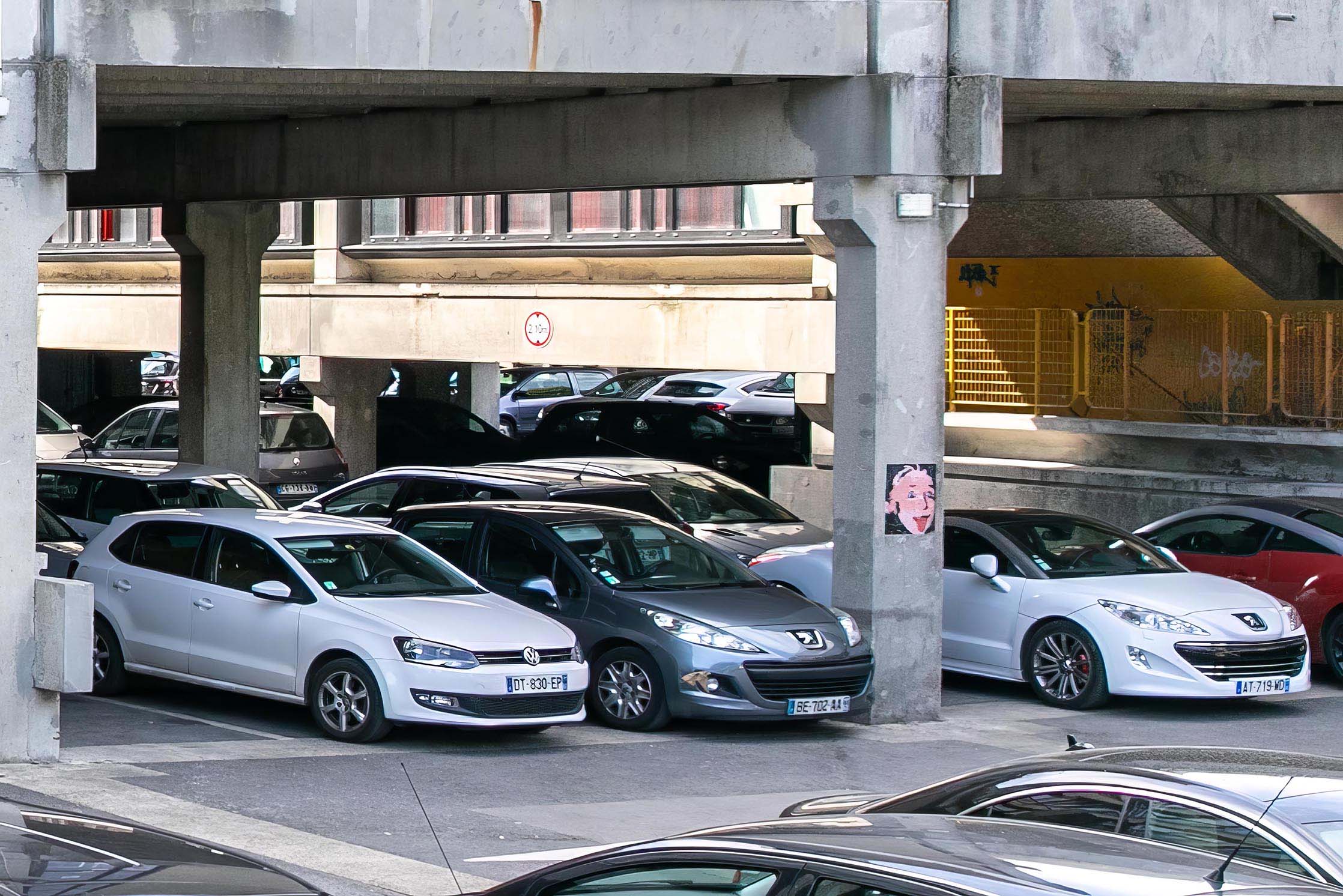

We already have this picture since 2017, and only 3 photos of parkings in Oise. Please can anyone confirm {{De minimis}} and {{PD-ineligible}}? Thanks -- Basile Morin (talk) 03:59, 15 February 2026 (UTC)

- While the original is public domain, the derivatives probably are not (they are Andy Warhol style and courts have ruled that Andy Warhol's art is "fair use" which means it qualifies both as sufficiently transformative to create a new use and to qualify as an artwork in its own right). The first photograph may be de minimis but the work is definitely not pd-ineligible, especially in France where even typographical arrangements enjoy full pma+70 protection. -Nard (Hablemonos) (Let's talk) 15:35, 15 February 2026 (UTC)
- If the basis for having the first one is that the art is de minimis and not the point of having the photo, then I'd suggest covering it with a Gaussian blur. - Jmabel ! talk 18:34, 15 February 2026 (UTC)
Dealing with invalid copyright labeling
[edit]User:Hellouser321 uploaded a bunch of images, with all of them labeled as "Own work", which is in some cases evidently false (ie. in File:Embarkation of the Pilgrims by Robert Walter Weir.jpg), and I suspect that the rest of the images are not their own work either. What is the correct way to deal with that? Can {{nsd}} be used on those images, or do I have to nominate them for deletion instead? Flexagoon (talk) 12:18, 15 February 2026 (UTC)

- @Flexagoon: mislabeling an image is not a valid reason for deletion. From the filename is is clear that the author of File:Embarkation of the Pilgrims by Robert Walter Weir.jpg is Robert Walter Weird. All his works are in the public domain so there is no reason for deleting them. The solution is to correct the license/authorship and guide Hellouser321 to correctly label their uploads in the future. They have only 26 edits so I assume they have little experience with licensing. Günther Frager (talk) 13:16, 15 February 2026 (UTC)
- Alright, thanks. What about cases such as File:Matt Par promoting YouTube Automation.jpg then? Flexagoon (talk) 13:28, 15 February 2026 (UTC)
- @Günther Frager also, would it make sense to speedily delete it if it's a duplicate of File:Brooklyn Museum - Embarkation of the Pilgrims - Robert Walter Weir - overall.jpg? Flexagoon (talk) 14:01, 15 February 2026 (UTC)
- Yes, when it is really a duplicate, not a different reproduction or retouched image. In this case, it does look like it is actually a duplicate of the same reproduction, with no added value. -- Asclepias (talk) 14:22, 15 February 2026 (UTC)
- @Günther Frager also, what about File:Francis Makemie before Lord Cornbury.jpg? There's no author name anywhere, does this mean it's a violation or not?
- Sorry for asking so many questions, the policies are just a bit unclear to me and I didn't find any place where they're thoroughly explained Flexagoon (talk) 14:30, 15 February 2026 (UTC)
- Strictly speaking, it's a violation if it's still under copyright. We don't keep it by policy if we can't determine if it's PD or not (and it has no other valid license). The uploader is supposed to provide all the information relevant to determine that. If there seems a reasonable chance that it's PD, it could be nominated for regular deletion if you don't feel like searching for more information, as the given information is clearly incorrect, but don't mark it as a "violation" (i.e. speedy deletion). That may give the uploader an opportunity to provide more information, or allow others to search. In this case, it seems like it's a [https://digital.history.pcusa.org/islandora/45279 painting by Category:Henry Alexander Ogden (American, died 1936) dating from circa 1900, so it should be fine as {{PD-old-80-expired}}. Carl Lindberg (talk) 15:18, 15 February 2026 (UTC)


Deletion request
[edit]I have a question for copyright issue. This image File:Resident Evil Requiem - 4ème Trailer.webm File:Resident Evil Requiem - 4ème Trailer.webm, and more was uploaded being licensed. But The problem is that the copyright assertion is based off Capcom France's upload, but Capcom USA's upload shows no such free-use license https://m.youtube.com/watch?v=hFDPKQbtfVE. Why is still such a thing that exist?? Boneless Pizza! (talk) 10:46, 15 February 2026 (UTC)
- @Boneless Pizza! In the description it gives this video, and at the bottom of the description it says
Creative Commons Attribution license (reuse allowed)
. However, the question is if Capcom France is authorized to release it under that license - you can start a deletion request about that. I think it's fine, as it's the offical channel. HurricaneZetaC 17:00, 15 February 2026 (UTC)- The correct Capcom USA link is [9] which isn't under CC BY. HurricaneZetaC 17:05, 15 February 2026 (UTC)
Is the Iron Maiden logo above TOO?
[edit]Hello!
I saw that the Iron Maiden logo is uploaded here on Commons and I thought that it might be above British TOO due to its distinct font.
It's apparently a modified version of a font called Busk. QuickQuokka [talk • contribs] 18:51, 15 February 2026 (UTC)